
An Article In Meteorite-Times Magazine
by Robert Verish
An Article In Meteorite-Times Magazine
by Robert Verish
The Bouse Meteorite - Part 2
Is there any evidence that Bouse (L4-6) is paired to NWA 869 (L4-6)??
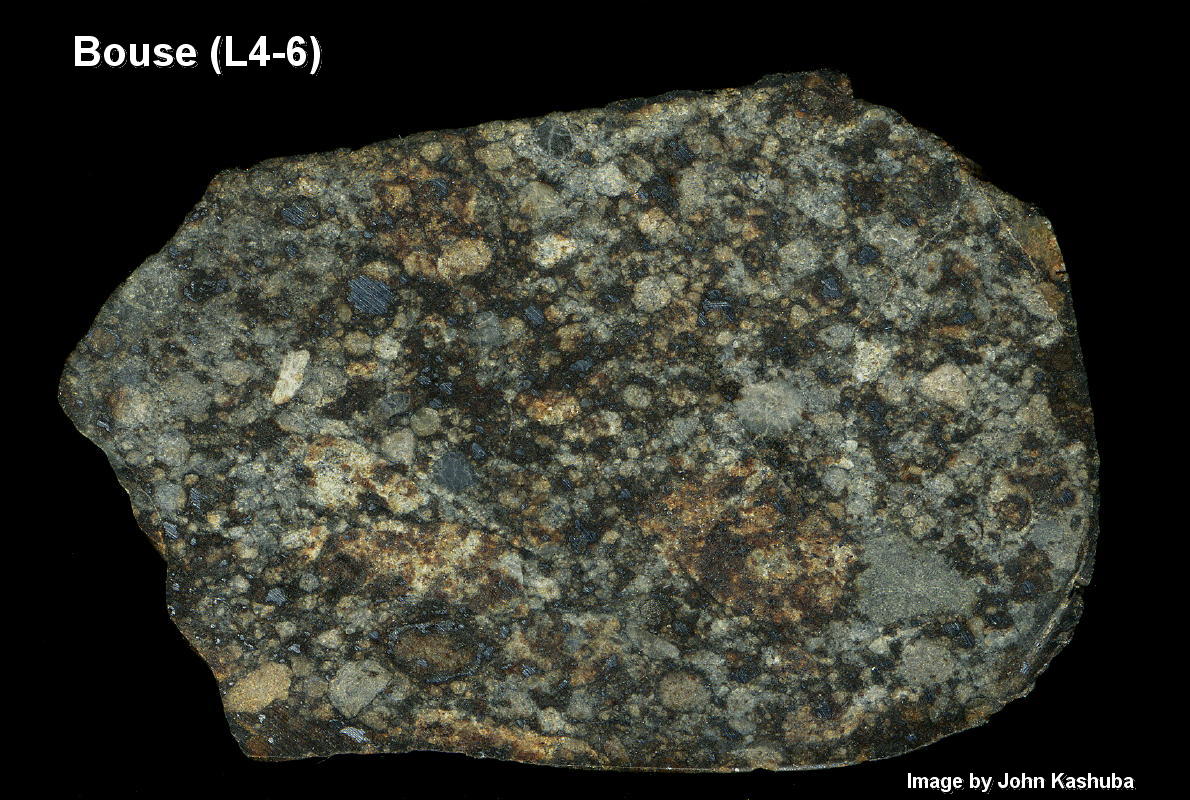
My article last month generated enough interest in the Bouse meteorite that I decided this topic deserved a "Part 2". Most of the replies I received centered on the speculation that "the Bouse meteorite looks so similiar to NWA 869, they must be paired". Apparently this topic was the subject of discussion on a number of Internet groups and mail-lists. The replies I received asked me what was my opinion on this matter.
My opinion is that, until there is hard evidence to the contrary, the Bouse meteorite is NOT PAIRED to NWA 869, and until the proper tests are conducted, speculating on the various characteristics that look similar between these two meteorites is just that, speculation. (By "proper tests", I mean the kind of cross-disciplined study that was conducted in Italy and was recently published in MAPS - March 2007)
What is not speculation is that both of these meteorites share the same classification. They are both classified as "L4-6". There are only 18 meteorites total that share this "L4-6" classification. It is generally assumed that most, if not all, of these "L4-6" meteorites came from the same parent body. But coming from the same parent body isn't proof that any of these "L4-6" meteorites are "paired". Belonging to the SAME FALL is the defining factor that determines if meteorites are "paired".
This is the same point that I was making in my June 2007 article about the Dutch Flat (IIAB) and its similarity to the Ainsworth and Sikote-Alin iron meteorites. Again, it is generally held that all of the IIAB irons originated from the same parent body. And again, it shouldn't be any surprise that Ainsworth and Dutch Flat and Sikote-Alin, all have very similar composition. But none of this proves that they are paired. There are other factors that will determine pairing. And given the well-developed desert-varnished patina on the exterior of the Dutch Flat iron, it shouldn't be considered paired to either Ainsworth or Sikote-Alin until a geochemist can determine its terrestrial age.
So, if NWA 869 and the Bouse meteorites are from the same parent body, it would be expected that they share similar petrologic characteristics, such as, armored chondrules, brecciation, light-colored clasts, dark inclusions, etc. But characteristics that are only shared among meteorites from the same fall, tend to more related to terrestrial processes specific to the find locality, such as adherred sand-grains and other weathering products. Therefore, it will be the exterior of these stones that have to be scrutinized to find the evidence for pairing, or as is more often the case, find evidence that precludes pairing.
For example, in the "cross-disciplined study" that I mentioned above, the researchers conducted forensic work that aimed to authenticate the recovery location of Castenaso, a 120 g ordinary chondritic (L5) meteorite reportedly found in 2003 along the sandy bank of the Idice Stream, near the village of Castenaso (Bologna, Emilia-Romagna, Italy). They examined:
1) the soil particles in fractures of the exterior of the Castenaso meteorite and compared them to the particles from samples from the "sandy bank of the Idice Stream" with a scanning electron microscope (SEM).
and
2) the geochemical alteration of the exterior by scanning with inductively coupled plasma-mass spectrometry (ICP-MS).
Again, these kind of tests will not necessarily prove two meteorites are paired, but it did clearly prove that the Castenaso meteorite was NOT FOUND at the reported recovery location. And, as long as the exact find locality for the Bouse meteorite is accurately reported, it will be just as easy to confirm that the soil particles from that locality match the soil particles cemented to the Bouse meteorite stones.
Then there is the question of are there researchers that would take an interest in conducting these tests on the Bouse meteorite. In the case of the Castenaso study the researchers were from Italian universities. And since universities would have Italian meteorites in their collections, they may consider themselves as stakeholders in such an authentication study. In the case of the Bouse meteorite the question is, would an Arizona university consider themselves as stakeholders and be prompted to conduct such a study? But if these tests should fail to exhonerate the Bouse stones, there is another approach that can be taken. This will require some additional work, such as, examining a number of NWA 869 stones in the same manner. If enough NWA 869 stones can be tested, it may be possible to develop a set of characteristics that are common to all NWA 869 stones. This would form a sort-of "baseline" that could be used in comparison with other meteorites. With a little bit of luck these tests may even find a particularly distinguishing, weathering characteristic that is unique to only NWA 869 stones. Given that stroke of luck, then the word "finger-print" would be a better term than "baseline".
In this particular case, if a similar examination of the few Bouse stones that we have available fails to find this unique fingerprint, then we can conclusively say that the Bouse meteorite is NOT PAIRED to NWA 869!

"Click" on the above image of the 15.7gram stone of the Bouse (L4-6) Meteorite for a Close-Up view!!
ADDENDUM:
This "Addendum" is where updates to this article will appear. For instance, images of the exterior of NWA 869 or other Bouse stones with sand-grains cemented to them could appear here in the future. The results of tests on on these stones will appear here, too. In subsequent updates, images of samples of terrestrial rock and soil taken from the Bouse find locality (which will be compared to the sand-grains in my Bouse specimen) will be displayed here, as well.
This "Addendum" is where reader's comments could be posted. The following is a reply that I received from a researcher at a European facility that has the equipment necessary to conduct the appropriate tests. My question was, "Can a study similar to the one conducted on the Castenaso meteorite be done on the Bouse or NWA 869 stones?"
Here are portions of the researchers reply:
"[It will] work if there is an exact locality for a meteorite known, and
caliche on the meteorite can be compared with [terrestrial] samples collected at
the same site."
"In the case of Bouse, the situation may be more favourable. The
attached grains look like well-rounded quartz, at least it should be
easy to find out whether similar quartz occurs at the find location."
"Further ways to look at quartz [sand-grains] would be using stable isotopes
and cathodoluminescence. Here it starts to produce a lot of work and you
need to find somebody who is willing to do that."
"... but [if the various Bouse stones are] coming from different areas the attached
stuff will also be quite variable."
"It would also be a possibility to look at the surface geochemical
alterations using nondestructive methods (XRF), but that would only
be useful if several meteorites [with certainty that they came from the same soil]
would be available for comparison."
"In summary, the most straightforward thing would be to look out for
soil containing sandgrains like the ones attached."
"It will always be easier to tell that a certain stone cannot come
from a specific area if there is a total mismatch, but if the
differences are not too large it will always be a matter of
argumentation."
Should anyone else have images of the exterior of their "Bouse stones", or of NWA 869 stones, I would be particularly interested in seeing those images, as well. And again, with your permission, I would like to post them to this addendum in future updates.
The Bouse meteorite was first published in the 2007 Meteoritical Bulletin No. 91.
If you have any information relating to the Bouse meteorite stones, please contact me by email: Bolide*chaser
UPDATE:
My other Bob's Findings articles on the Bouse Meteorite:
| August 2007 |
The Bouse Meteorite
Image Gallery of the original 15.7 gram stone |
| November 2007 |
Sand Encrusted Stones of the NWA 869 Meteorite
Sand grains from the Sahara Desert are caliche-cemented to the exterior of unwashed chondritic stones of the NWA 869 meteorite. [See the "UPDATE" in the November 2007 article.] |
After I published this article, I discovered that there was something wrong with my Bouse specimen.
It had been stated by the finder and the classifier that the "3 original stones" of the Bouse meteorite "had never been cleaned", but upon closer examination of my specimen, it was evident that this wasn't the case.
Whether the exterior of my "Bouse" meteorite with the residual sand-grains in the cracks is the result of natural weathering, or scrubbing (by human hands), the cause of the alteration to my 15 gram specimen may never be resolved. But in any case, this was the "last straw" in a series of red-flags that have been raised concerning the provenance of the "Bouse" finds. Comparing the exterior of this "Bouse" specimen with one of my "dirty" NWA 869 that was "scrubbed", and with other NWA 869 specimens that were advertized as being "cleaned by the dealer prior to their sale", showed VERY LITTLE DIFFERENCE in gross appearance, and residual quartz-grain morphology.
A proper scientific study of the sand-grains still needs to be conducted. But, there is little interest, now, in conducting such an analysis, if it is only going to prove that the sand-grains on the Bouse and NWA 869 meteorites are "paired".
(That's not to say that this wouldn't be a valid scientific inquiry. It's just that it would be a forensic study, and not really a meteorite study. And considering the "negativity" that would result from a "proved pairing", it appears that the general consensus is that the less said, the better.)
REFERENCES:
"Authenticating the recovery location of meteorites":
The case of Castenaso Abstract on IngentaConnect.com
Photo of Bouse (endcut) from the Collection of LARRY SLOAN:
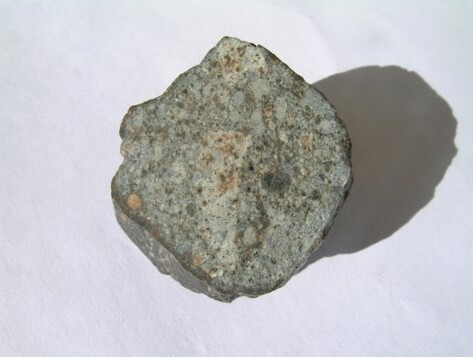
http://www.encyclopedia-of-meteorites.com/test/bouse_larry_sloan.jpg
Photo of Bouse (slice) from the Collection of JAN WORECZKO:
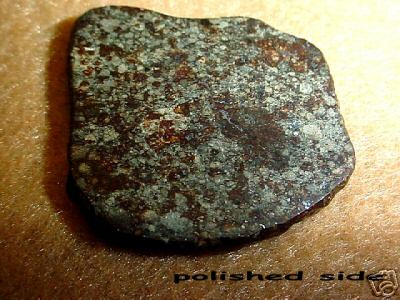
http://www.encyclopedia-of-meteorites.com/test/35487_3705_183.jpg
Google Earth - find location for Bouse meteorite according to Meteoritical Bulletin:
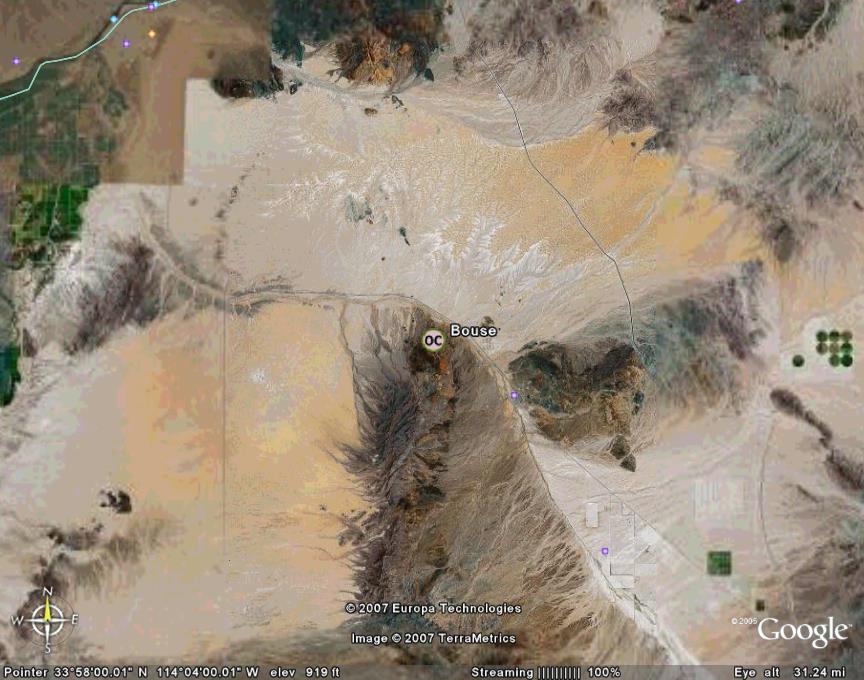
"Click" HERE for link to download the Meteoritical Bulletin location file (meteorites.kml) on Google Earth.
Google Earth - "actual" find location for Bouse meteorite, according to anonymous meteorite hunter:
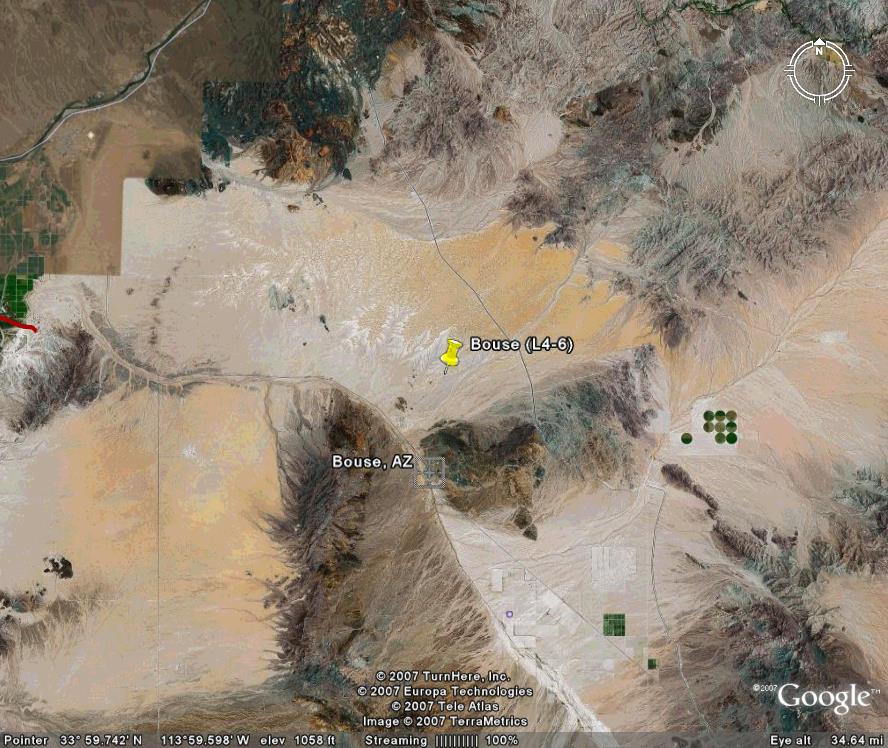
Google Search result for
BOUSE strewnfield: "Where is this field located?"
La Paz County, Arizona:
http://en.wikipedia.org/wiki/La_Paz_County,_Arizona
Bouse, Arizona:
http://en.wikipedia.org/wiki/Bouse%2C_Arizona
The Bouse Formation:
GSA 2007b Abstract on Bouse Formation
"...lacustrine origin for the Upper Miocene to Pliocene Bouse Formation...":
http://bulletin.geoscienceworld.org/cgi/content/abstract/109/6/767
"Mineralogical maturity in dunefields of North America, Africa and Australia":
Abstract in Science Direct - comparison of sand in dunefields
"Eolian Sand Transport Pathways in the Mojave Desert":
http://esp.cr.usgs.gov/info/sw/eolian/
Source for the sand grains in the Parker Dunefield determined:
"A more detailed chemical analysis of the sands backs up Muhs' contention. Samples of Mojave sands all have less than 79 percent quartz and greater than 10 percent aluminum oxide, says James R. Zimbelman, a geologist at the Smithsonian's Center for Earth and Planetary Studies in Washington, D.C. Meanwhile, samples of sand from the Parker dunes all have greater than 81 percent quartz and less than 6 percent aluminum oxide. Those percentages are indistinguishable from those of sediments taken from the Colorado River.
Also, grains of sand from the Parker dunes seem to be rounder and more weathered and therefore probably are older than the freshly eroded Mojave sands. Zimbelman and Steven H. Williams of Colorado Springs, Colo., published results of their analyses in the April Geological Society of America Bulletin."
http://www.sciencenews.org/articles/20021019/bob9.asp
Electron microscope images: several studies show the surface of various sand grains:
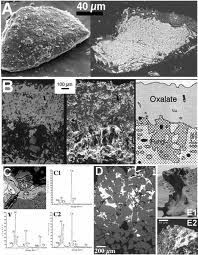
http://alliance.la.asu.edu/dorn/VarnishPages/RockCoatingsWeb/DesertRockCoatings.html
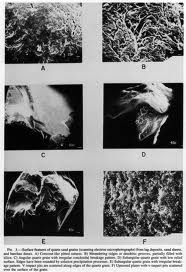
AAPG/Datapages, Inc. DOI Citation
Sand, Scanning electron microscope image sequence, pan across sand grains showing texture.
http://www.amazon.com/Atlas-Grain-Surface-Textures-Applications/dp/0195138120
"Sands of the World":
http://www.chariho.k12.ri.us/curriculum/MISmart/ocean/pixindex.html
"Studies involving the source of sand grains from Arizona deserts":
http://www.desert.com/petroweb/learn.php
"Sand grains from the Sahara Desert":
http://www.chariho.k12.ri.us/curriculum/MISmart/ocean/gallery1.htm
"Virtual Microscope Interface":
http://virtual.itg.uiuc.edu/data/index.php#LM_nwa869.jar
"The Life & Love of Sand Dunes"
(Text & Photos by Wayne P. Armstrong):

http://www.desertusa.com/magjan98/dunes/dune2.jpg
"MeteoriteArticles.com":
http://www.meteoritearticles.com/coltessera.html
The Mark Bostick article, as it was discussed on the Meteorite-List.
For for more information, please contact me by email:
Bolide*chaser
